

The pelvic bowl is a vessel shaped like a butterfly. It houses many of the organs that belong to the Water Phase, including the Womb, Fallopian Tubes, Ovaries, and Urinary Bladder. Together, these organs give us the gift of creativity, fecundity and the release of the the nourishing Waters that return to Mother Earth.
Understanding your pelvic floor
It may be helpful to visualize your pelvic floor as a hammock that supports all your lower organs. The flexibility and strength of this hammock come from a set of muscles and ligaments interwoven into the bowl-like pelvic walls. They work together to create a strong foundation, closing in at the base to form the pelvic and urogenital diaphragms. These structures are vital for the proper function of the urinary and reproductive systems.
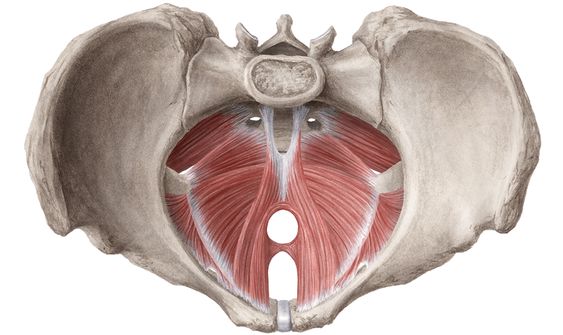
Locating your Pelvic Floor muscles
1. Feeling the Pelvic Floor muscles under pressure
In a sitting position, blow strongly into a balloon or mime the same action. You will feel a region in the lower pelvis that comes into play as you blow. This is the pelvic floor region.
2. Feeling and testing 3 different responses when you blow into the balloon:
- Feeling like needing to pee
- Pressure on the pelvic floor
- Contraction and movement in the region
3. Paying attention to your Pelvic Floor during daily activities like:
- Coughing
- Speaking loudly
- Laughing
- Holding your breath while exerting yourself, like when lifting something heavy
- Blowing out a candle flame
In all these situations the pelvic floor muscles are put under pressure. Now you can see that these muscles can be recognized and activated by consciously engaging them in your day-to-day activities.
Mapping the Pelvic floor with exercises
These exercises will allow you to coordinate muscular contractions of the superficial muscles of the pelvic floor with ordinary everyday breathing patterns. At the beginning you will do this while performing these exercises. Then you will begin to notice that you do it automatically whenever necessary.
1. Contracting the muscles from front to back
Lie down on your back. Bend your knees, putting your feet flat on the ground in front of you. Flatten your back. In this position try to actively draw your coccyx and pubis toward each other . Relax and repeat. You are trying to feel a contraction along the median line of the perineum (central tendon). Do not try to contract deep within the pelvis, nor should you look for a sensation of lifting. Rather focus strictly on the back-to-front or front-to-back direction. The movement that you are trying to feel is just along the median line and close to the skin. Try to avoid contacting the sphincters.
2. Contracting the muscles from side to side
Now try to make a muscular contraction as though you were actively drawing your two ischial tuberosities (seat bones) toward each other. The line of contraction is very different form the previous exercise. Here the muscles that are called upon run from side to side (the superficial transverse muscles). Try to feel a line running only along that one direction, and no longer from the front to the back. You can touch the area just inside the seat bone to feel the contraction.
3. Varying the type of contractions
When you have found the lines of contraction try to find them one at a time using the following progressions:
- A long contraction: Hold the contraction for 7 secs and then let go and relax for twice as long. Breathe deeply as you relax. Repeat exercise 5X.
- Strong, quick contractions: Now contract the muscles as strongly as you can. Keep them contracted for no more than 2 secs. Relax completely.
After contracting each muscle remember to relax it completely. This moment of relaxation is very important. You need to be able to recognize the two muscular lines before the next exercise.
4. Crossed contractions
You are still lying down. Try to contract the two lines simultaneously. This may give you a sensation of pulling together the two lines of a cross drawn across the base of your pelvic floor. The contraction is “flat”, there is not “lifting”.
Follow the process described in step 3.
5. Coordinating the contraction with your breathing
~ Contract your muscles while exhaling for about 15 seconds, making a soft “SSSSSSSSS” sound.
~ Now, exhale again, but this time, use the sound “FFFFFFFFF”. Make sure to let your breath out a bit faster.
~ And finally, breathe out with a long “HHHHHH” sound. Notice how your breath comes out even faster this time.
Performing these exercises regularly can help you maintain a toned pelvic floor. This is particularly important because we often neglect to use these muscles in our sedentary daily routines.
Always remember that following a strong muscle contraction it’s crucial to allow an equal period of relaxation or rest.
References:
“The Female Pelvis, Anatomy and Exercises” by Blandine Calais-Germain
 Healing Cycles